
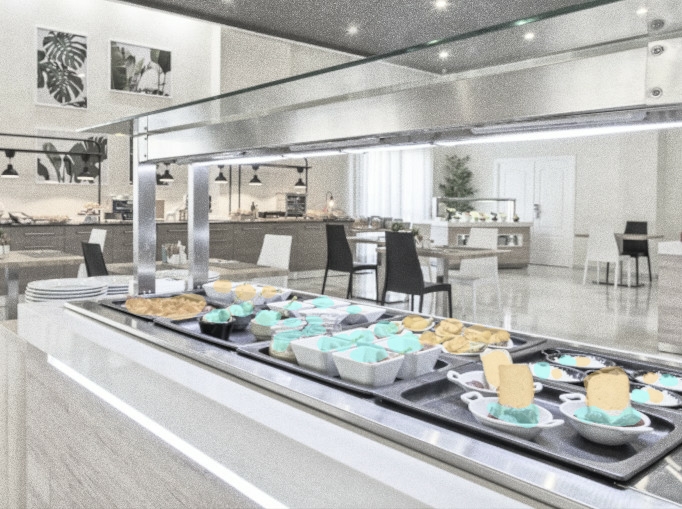
If it is not measured, it is not reduced. And if it is not evidenced, it does not exist. In food service, this can be seen every day: decisions are taken “by eye”, habits are repeated, and in the end waste becomes a silent cost… and a risk.
The figures are hard to ignore: in Europe, 58 billion kg of food are wasted every year, and a significant share of this happens outside the home; hospitality accounts for around 11% of that waste. Behind this there is not only food: there is social impact (perfectly usable food that does not reach anyone) and also economic impact (purchasing, energy, team hours and waste management).
That is why regulation is coming, and that is why the game is changing: it is no longer enough to “do it well” from time to time. Hotels and restaurants are going to need a system that allows them to plan, measure and trace what happens to surplus: what is prevented, what is recovered and what is correctly managed. The good news is that, when you do it simply, it is not bureaucracy. It is control and saving.
In Europe, 58 billion kg of food are wasted every year.
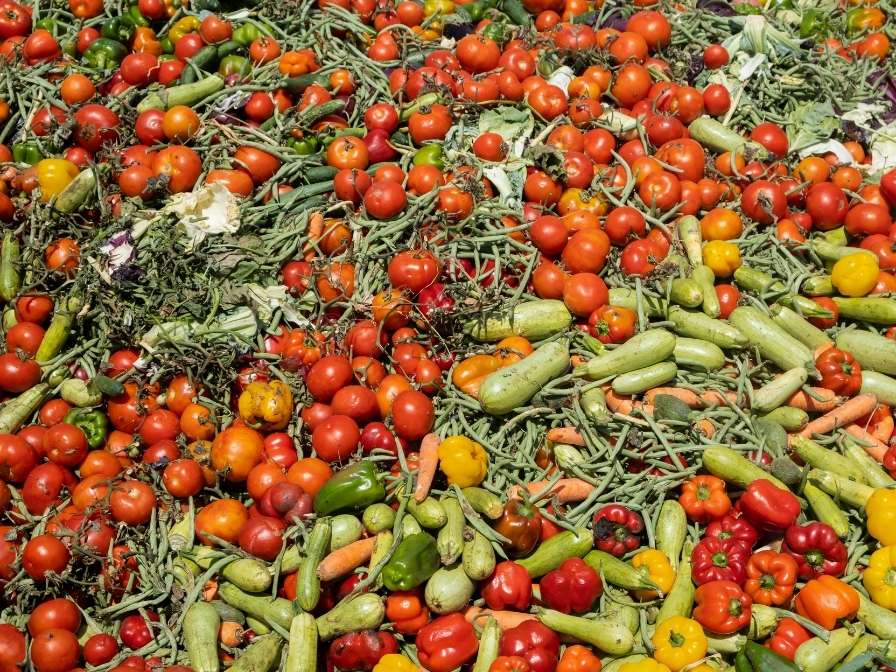
Measuring food surplus also means saving money and gaining control
Measuring is not about putting an extra burden on the kitchen. Measuring is, quite literally, about seeing. Because if you do not know what is left over, where it is left over and when it is left over, you can only “guess” and keep buying and producing out of habit.
The key is to start with a minimum approach that is useful and sustainable for the team. We are not looking for the perfect data point. We are looking for consistent data.
And here comes the point that usually changes the conversation: every kilo of food that ends up as waste has already cost you money before you throw it away. In reference guides for food service, a conservative calculation of around €3 per kg is used just for purchasing cost (not including energy, staff, storage or waste management).
That is why measuring is not “control for the sake of control”. Measuring allows you to say, with demonstrable data: “this month we avoided 120 kg of waste” → and that is already around €360 of purchasing that you did not throw away. And when you do it properly, you can show it: not as a nice claim, but as evidence of improvement (and of margin).
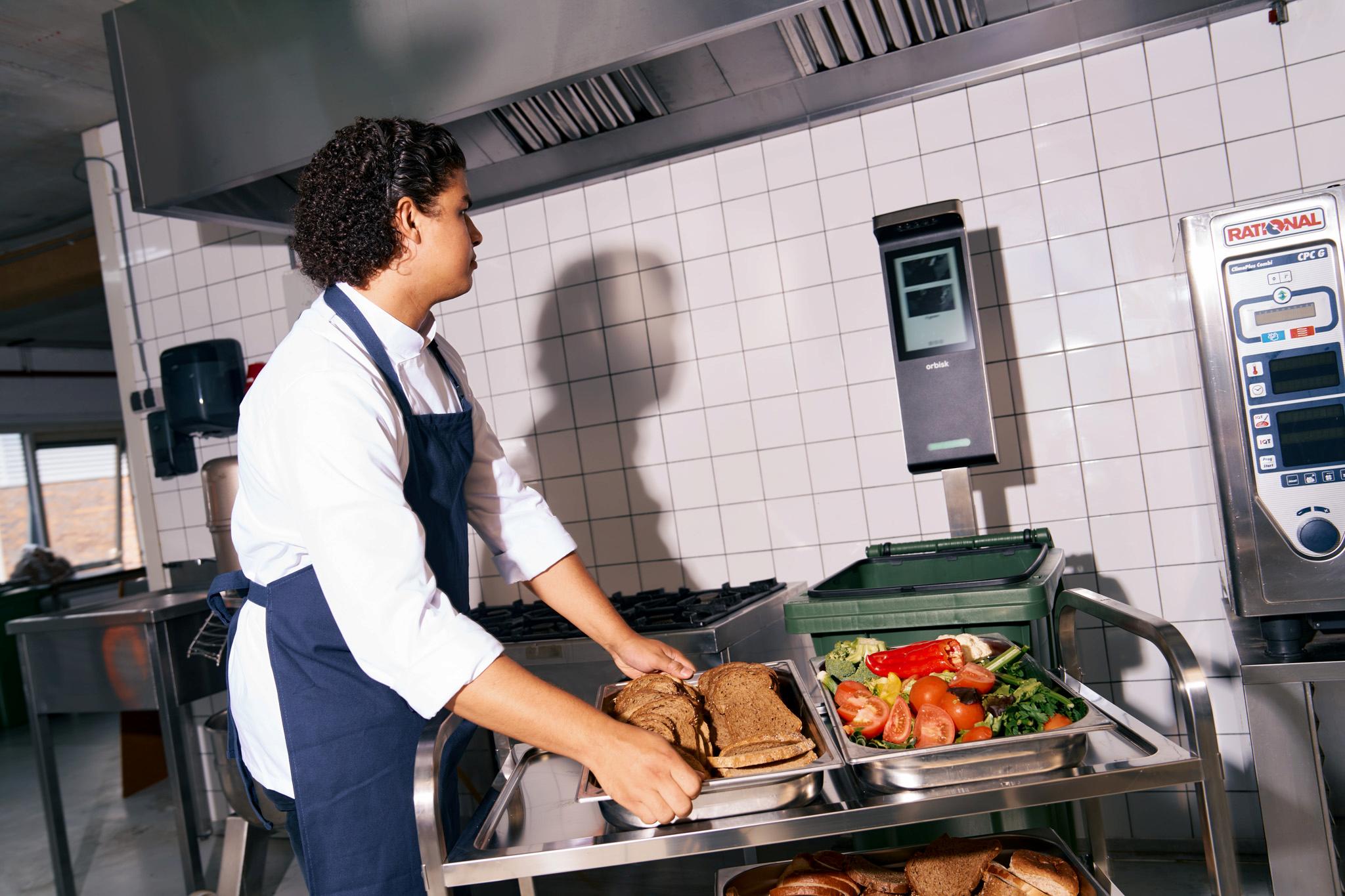
Companies such as Orbisk and Effiwaste offer solutions for weighing surplus food.
What does it mean to measure realistically in a hotel or restaurant?
It means measuring what genuinely helps you make decisions, without interrupting service. For example:
- Breakfast buffet case (hotel): you detect that almost full trays of pastries come back every day and that cut fruit remains untouched after a certain time. Measuring allows you to adjust replenishment and format: fewer large trays, more small replenishments, and whole fruit instead of cut fruit at the end of service.
- Banquet/event case: you see that what comes back most are side dishes (potatoes, rice, salad) and bread. Measuring helps you correct standard portions without affecting the quality of the main dish.
- À la carte restaurant case: a pattern appears: the “star dish” sells, but always comes back with half of the side untouched. Measuring helps you redesign the plating and save money without the customer perceiving it as a cutback.
At the end of the day, measuring means answering three simple questions with data: what is left over, in which moment/service, and why.
Which surplus flows should be traced: “unserved and under control” vs “post-consumption”
To measure properly from day one, you do not need to measure ten things. You need to measure with judgement. And the most important criterion in hotels and restaurants is this: not everything that is left over can be channelled. That is why the minimum viable approach should separate two worlds that the team understands immediately:
1) “Unserved and under control” surplus (recovery traceability)
This is what is left over in the kitchen or on the pass without having entered the service circuit. Here it does make sense to talk about recovery traceability because there is control and, therefore, it can be linked to actions such as internal use, planned transformation or, where there is a channel and it applies, charitable redistribution with agreements, as for example a pot of soup or stew that was never brought out, extra rice production that remained in the kitchen unserved, or packaged/unopened product (where applicable).
2) “Post-consumption / exposed” surplus (management and recovery traceability)
This includes what comes back from the dining room and what is removed from the buffet after having already been displayed. This surplus is also traced, but it is traced differently: not as recovery for consumption, but as correct management and recovery (organic waste, composting, biogas, waste operator, etc.). And it is key to measure it because it is what best shows you where to adjust production. Here you have some axamples like replenishment and portions, as for example plates with the side dish untouched (potatoes/rice/salad), leftovers removed from the buffet at closing time after being on the line, or mixed bread and pastry returns from the dining room.
And add one simple denominator: number of covers per service. With that, you can already obtain a useful indicator: grams per cover, which allows you to compare weeks and decide actions without arguing over opinions. Very simple examples:
-
- Breakfast buffet: 180 covers. 5 kg of post-consumption surplus are recorded (bread + pastries + fruit from the line) and 2 kg of “unserved” surplus in the kitchen (production that never came out). Result: around 28 g/cover post-consumption + 11 g/cover unserved. The following week you adjust replenishment and reduce post-consumption surplus by 20%.
- Staff meal: you detect that every Monday 3 kg of pasta remain unserved in the kitchen. You adjust production and that “unserved” surplus is reduced almost to zero.
- À la carte dinner: returns are low, but “unserved” surplus is high in one preparation (for example, soup). That points to overproduction (planning), not customer rejection.
What matters is this: with this minimum, you can already make a diagnosis and improve, while also making the correct traceability of each flow clear: recovery where there is control, and management/recovery where it is already post-consumption. When you record it consistently, you are no longer “having an opinion”: you are managing.
Traceability in hotels and restaurants: the difference between “doing” and “proving”
This is the important leap: measuring helps you improve, but tracing helps you prove. And today, proving is no longer optional. More and more, hotels and restaurants need evidence for audits, ESG reporting, certifications and to avoid the risk of promising things that they cannot later prove.
What is traceability in this context?
Traceability means leaving a clear and verifiable record of:
- what surplus is generated (and when)
- what is prevented or recovered (specific action)
- where it goes (destination)
- with what evidence (document, record, receipt, photograph, delivery note, etc.)
In other words: moving from “we do it” to “here is the proof”.
Traceability is not “more work”. It is order.
What kills teams is not recording: it is recording twice, in different places, without a common criterion. That is why a single repository (a “living space”) where what really matters is concentrated makes sense.
What is worth tracing (beyond the kilos thrown away)
This is where your differentiating approach comes in: not only tracing waste, but tracing avoided waste and circular outputs. For example:
- edible surplus channelled (traceable charitable redistribution, with agreements and logistics)
- product close to expiry relocated or returned (real prevention)
- used oil managed with an operator and receipt (clear and easy chain)
- organic waste with the right destination (composting/biogas/operator), with evidence
That is what turns management into a serious system: decisions + channel + proof. And, in addition, it has a huge advantage: when you trace properly, you can work better with third parties (social organisations, operators, suppliers, certifiers). Circularity is networked work. Traceability is the common language.
The part that almost nobody plans: what to do with edible surplus
Most establishments already do some things well: they reuse, reorganise, sometimes “the staff keep it”, sometimes “we collect it however we can”. That is not the problem. The problem is that, if there is no prepared channel, that management remains informal: it depends on who is there, whether there is time, whether someone knows someone. And the informal, as soon as there is pressure, usually ends up in the bin.
The edible channel should be designed as a “service”, not as a favour
For edible surplus to be genuinely used, it has to be easy. As easy as taking a box out to the loading bay. That means thinking about the channel with an operational logic:
- Who it goes to (nearby organisation, food bank, soup kitchen, local initiative, etc.)
- When (clear window: for example, “from 11:30 to 12:00” after breakfast, or “at 22:30 when it leaves the kitchen”)
- How (packaging, minimum labelling, delivery point)
- Who does it (a named person: “shift manager” and “external point of contact”)
When this is defined, the change is enormous: it is no longer “let’s see if we can do it today”. It is “this is what we do when it happens”.
Imagine a hotel that knows that on Sundays there is usually bread, pastries and fruit left over. If the channel is set up, the team does not have to think: they prepare 2–3 standard boxes, leave them at a defined point, and that is it. If it is not set up, that surplus is at the mercy of end-of-day fatigue. And it is usually lost.
Packaging and logistics: what makes a channel viable (or hell)
Here is the detail that almost nobody wants to look at… and yet it is what determines whether it works. The edible channel fails for two reasons: because it bothers the team or because the recipient cannot manage it. The solution is not “more goodwill”. It is simple design.
Three very everyday examples:
- if surplus is delivered in different packaging every day, without order, the recipient becomes overwhelmed
- if the hotel does not know who is collecting it and at what time, the team experiences it as an interruption
- if the cold-chain side is not resolved (even with a basic criterion), everything turns into “better not”
What works is the opposite: standardise. Two types of packaging. A minimum labelling system (date + contents). A fixed delivery point. And clear logistics: either the organisation collects it, or an operator collects it, or a specific circuit is agreed. But it is agreed.
And in many cases, in addition, a mixed channel can be designed: one part is allocated to internal use (for example, bases and planned preparations) and another part goes to the social channel. The important thing is that each output has a “lane”. Lanes prevent improvisation.
What changes the game: simple agreements and light evidence
We are not talking about bureaucracy, but about security and order. A simple agreement with an organisation (even a basic one) does two things: it protects the hotel and it protects the recipient. And, in addition, it allows something very valuable: traceability.
Tracing here is not about creating an endless spreadsheet. It is about being able to say: “This edible surplus left here, went to this organisation, in this format, with this frequency”. And leaving light evidence: a receipt, a record, a confirmation. With that, the hotel moves from “we did it” to “we can prove it”.
An example: a restaurant closes every night with 8–10 unserved portions of vegetable soup and rice. If it leaves it to chance, one day it is lost, another day it is used, and there is no consistency. If it agrees with a nearby organisation on a collection twice a week, and standardises packaging and handover, that surplus stops being a problem and becomes a managed flow. And it is also recorded.
Circularity as a network: nobody solves it alone
This is the point that many underestimate: the management of edible surplus is not done solely “inside” the hotel. It is done in connection with others: social organisations, operators, logistics providers, suppliers, even local authorities. That is why, when we talk about traceability in hotels and restaurants, we are also talking about ecosystem.
A hotel can have the best intentions in the world, but if it does not have a nearby channel, or if there is no logistics, or if there is no clear agreement, edible surplus ends up being mixed with non-edible surplus. And that is where value, impact and reputation are lost.
Planning the edible channel is not about adding work: it is about removing friction from day-to-day operations. It is what allows circularity to happen when the team is tired, when service has been hard, and when there is a rush. If, at that moment, the system is simple, it works. If it depends on “remembering”, it does not.
From waste to resource: recovering non-edible surplus with agreements (and proof)
When surplus is not edible, many people assume it is “lost”. And that is true: we are no longer talking about a social channel. But that does not mean it is an end without value. It means that the focus changes: here the key is to recover it properly and leave evidence (without complications).
In practice, there are two paths that genuinely work: agreements with third parties for traceable recovery or on-site composting. Everything else is usually noise.
1) Traceable external recovery: agreements that turn waste into a clear chain
The simplest route (and the most replicable) is to agree with specialist operators on the collection and recovery of certain flows. There is no need to invent anything strange: it is about choosing 2–3 “easy” flows and turning them into routines.
Very typical examples in hotels and restaurants:
Used cooking oil: drum → collection by the operator → receipt → recovery (biodiesel or other).
This is perfect because it is naturally separated and usually comes with a delivery note.
Coffee capsules (or grounds, depending on the system): specific container → collection → certificate/receipt → recycling/recovery.
Here the value is not the kilo, it is the demonstrable story: “we do not throw it away; we manage it through a circuit”.
Recurring packaging or materials (depending on the hotel): glass, cardboard, certain plastics, even amenities if there is a return programme.
The important thing is to choose what is realistic and easy to maintain.
In all these cases, traceability is not about “measuring the container”. It is about being able to prove the chain: who collects it, how often, and with what receipt. With a photograph of the collection point and a monthly delivery note, you already have very solid evidence, without bureaucracy.
2) On-site composting: when the hotel can close the loop internally
On-site composting can be an excellent solution… if it fits the reality of the establishment. It works especially well in hotels with a garden, kitchen garden or an operation that can absorb that compost. And here what matters is that it should be sustainable over time, not a project that starts with enthusiasm and dies after a month.
A realistic example: a hotel with green areas decides to compost vegetable preparation scraps (peelings, clean trimmings) and use the compost in gardening. If it is well organised (fixed point, responsible person, routine), the result is a very powerful cycle that is easy to explain: kitchen → compost → garden.
So what does “traceability” in waste recovery mean in hotels and restaurants?
Here, tracing is not about proving “that you throw it away”. It is about proving which waste you have managed properly, with whom, when and to what destination. In other words: turning recovery into a verifiable flow.
For example:
- used oil or coffee capsules: collection by an authorised operator + delivery note/receipt + recovery destination
- collection by the same supplier: collection circuit + receipt/certificate from the operator
- composted organic waste: simple process log + evidence of use (garden/kitchen garden) if it is on-site composting
The idea is very simple: circularity does not depend on “having good intentions”, but on having agreements, responsible people and light evidence that anyone can review (audit, ESG, certification or inspection).
Conclusion: traceability turns effort into competitive advantage
In hotels and restaurants, the difference between “doing sustainable things” and managing professionally is simple: having a system. Planning what to do with surplus, measuring the minimum that matters and tracing what is recovered and recovered for value is not bureaucracy: it is control, efficiency and credibility.
In addition, traceability in hotels and restaurants is not an individual issue. It works when it is connected to the ecosystem: social organisations, operators, service providers, suppliers and clear agreements. That connection turns surplus into a managed flow, and management into evidence.
At Revivack, we approach it in a practical way: we help the hotel move from isolated actions to a living Circular Pass, where the plan, the flows, the agreements and the evidence are organised. A single place to demonstrate what you are already doing well, and to improve what is currently being lost for lack of a system.
If you want to start without friction, the best decision is not to “do it perfectly”, but to do it consistently: one first edible flow agreed properly, 2 measurement categories and 2–3 traceable recovery chains (for example, oil, capsules or composting). From there, reduction and traceability come almost by themselves, because the system is already in place.