
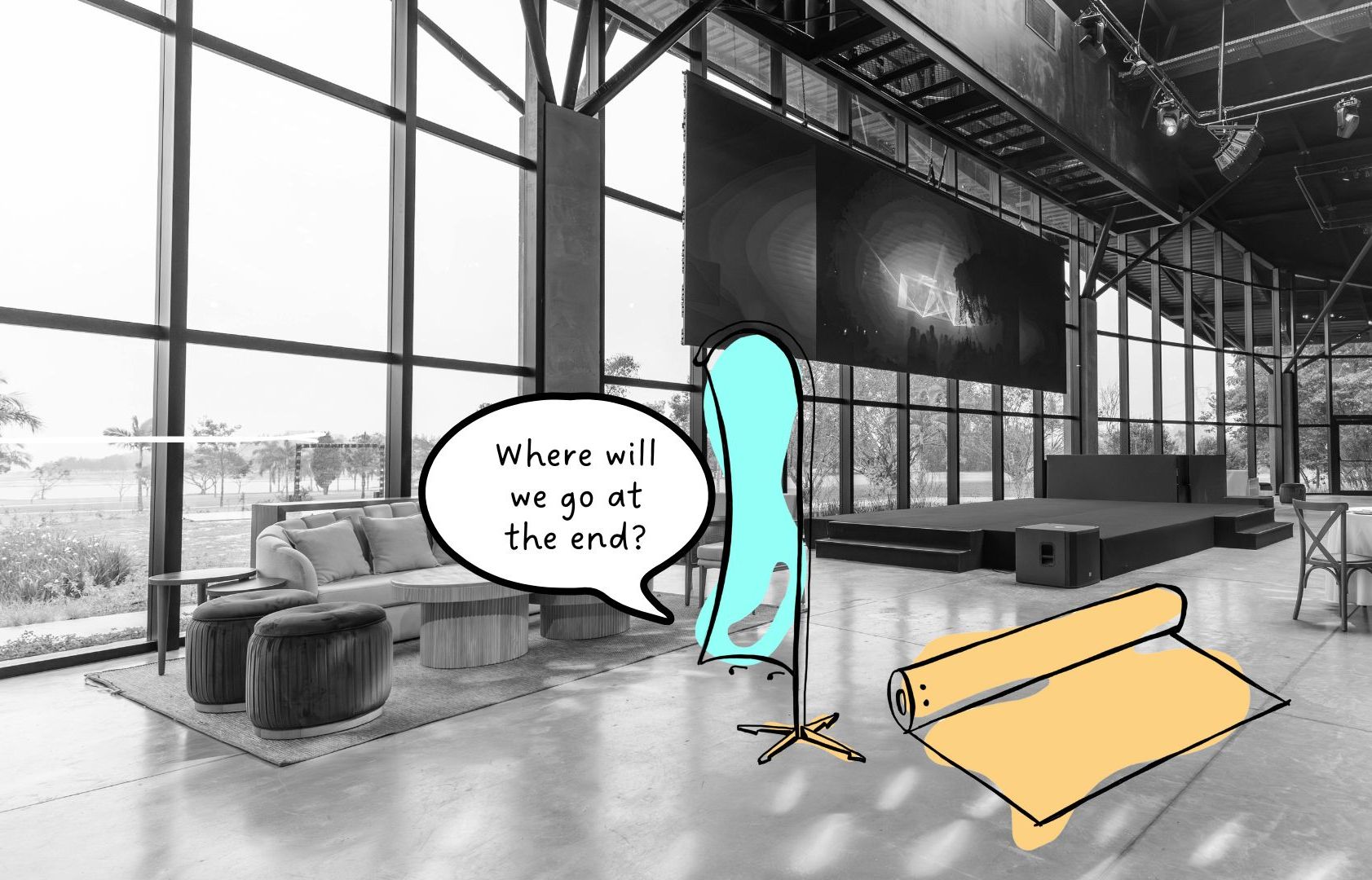
Every time an event ends —a fair, a congress, a festival— the dismantling begins. Stands are taken down, boxes pile up, and what just hours ago was a vibrant space suddenly becomes empty.
And in that moment, far too much ends up as waste: not only reusable structures, but also consumables like leftover food, uniforms, signage, even tableware.
Although many event organisers are already taking steps towards sustainability, the truth is that most of the materials used are not recovered or tracked properly. And this is not because of a lack of willingness, but because there are no clear, shared mechanisms in place.
What happens after the dismantling an event?
Picture this: Your event is over. Everything went well. But then, in the following hours, someone – maybe maintenance, maybe the contractor- collects the 20 custom posters designed specifically for this edition. Nobody really knows what happens next. Are they stored? Discarded? Recycled? Where do they go?
The same happens with uniforms, stage vinyls, the branded photocall, or the rental furniture.
Each element has its own recovery path… but that path is rarely planned.
The key is how (and with whom) we do it
Making an event circular should not feel like a burden.
In fact, when it is done as a shared effort, with the right tools and clear roles, it becomes an efficient, transparent and reputation-building practice.
Based on experience, there are 3 key principles that separate good intentions from events that truly create positive impact:
1. Plan ahead, together with those who know best
Circularity starts before the event, with one essential question: What will be used, and how can it be recovered?
Suppliers bring very different products, materials and services: catering, furniture, graphics, technology, decoration.
And each item has its own way back. The organising entity doesn’t have to know it all. But it can – and should – bring suppliers into the conversation early. They know best how their products can be recovered, and what it takes to do it right.
2. Tidy waste and shared responsibility
One of the biggest mistakes in sustainability is assuming that everything is the organiser’s responsibility.
In reality, circularity works when every actor takes care of their part.
During dismantling, it’s crucial to know what will be collected, how, and by whom. We call this tidy waste — the opposite of the usual chaos at the end of an event. And tidy waste is not just a nice-to-have. It’s essential for proper recovery.
When materials are mixed together – wood with plastic, food with paper, textiles with electronics – nothing good comes out of it.
Disorder kills recovery. Each product has its own path, and only by keeping things separate and managed correctly can those paths be respected.
Effective recovery cannot depend on a single player. It requires a collaborative network with clear processes and shared responsibility.
3. Real traceability: goodbye greenwashing
Circularity only matters if it can be proven. Traceability turns promises into facts.
Being able to know – and show – how many kilos were collected, where they went, who managed them, and how much CO₂ was avoided is essential. Not just to measure impact, but to build credibility.
Because reputation is on the line. Today, audiences, clients and partners demand evidence. Greenwashing doesn’t fly anymore.
What if this was easier than it sounds?
This is where the concept of the Courtesy Circular Pass® comes in.
When an event is registered on the Revivack platform, a digital space opens up where suppliers can be invited to join.
Each one receives a free Courtesy Pass, which allows them to:
-
Register the products or services they will provide
-
Connect with authorised recovery managers
-
Contribute traceability to their materials and services
This way, all individual efforts come together in one place: the Event Circular Pass®.
A simple tool to coordinate, visualise and prove circularity in real time.
Anything can be circularised
This isn’t just about recycled wood or reusable carpets.
You can also trace:
-
Rental furniture
-
Leftover food
-
Tableware
-
Work uniforms
-
Merchandising
-
Posters, banners and vinyls
-
AV equipment, even if rented
The key is to integrate them all into a single system.
And to work as a team.
Conclusion
Making an event circular is not a technological challenge – it’s an organisational and collaborative one. It doesn’t require huge budgets or complex systems. It requires planning, shared responsibility and traceability. Above all, it requires a mindset shift: moving from “doing it all alone” to doing it together, with purpose. The result?
Events with real impact, avoided waste, reduced emissions, verifiable data, and stronger reputations.
Events that don’t just happen, but leave a positive footprint.
👉 Ready to try it? Start here:
https://app.revivack.com