

Is a circular product the same as a recycled product? Although both concepts are related to sustainability and waste management, the answer is a resounding NO. Let us explain the differences, the advantages of a circular product and its benefits for the environment.
Recycling: an important but incomplete step
A recycled product is one that is made in whole or in part from materials that have been discarded and transformed into new products. For example, a plastic bottle that has been turned into another plastic bottle.
Recycling, as we know it today, is the process by which the materials used in its production have been collected, processed and transformed into new products.
Although it is an essential part of sustainability, recycling has its limitations. The main limitation is that it remains linear, as most products made from recycled materials cannot be recycled again.
Why can’t most recycled products be recycled again? There are several reasons:
- Because the recycled material used has been mixed with other materials and is not recoverable. For example, if you mix recycled polyamide from fishing nets with carbon fibre and make a vacuum cleaner out of it = RIP.
- Because not all recycled materials are recyclable, and those that are often degrade after several recycling cycles, the resulting material is of such low quality that it is not suitable for reuse – this is known as ‘downcycling’.
- Because the products are not designed for reuse, they are difficult to disassemble and complex to recover.
- Because they are simply collected in a haphazard way and never get to the right place to be properly treated and their raw material recovered.
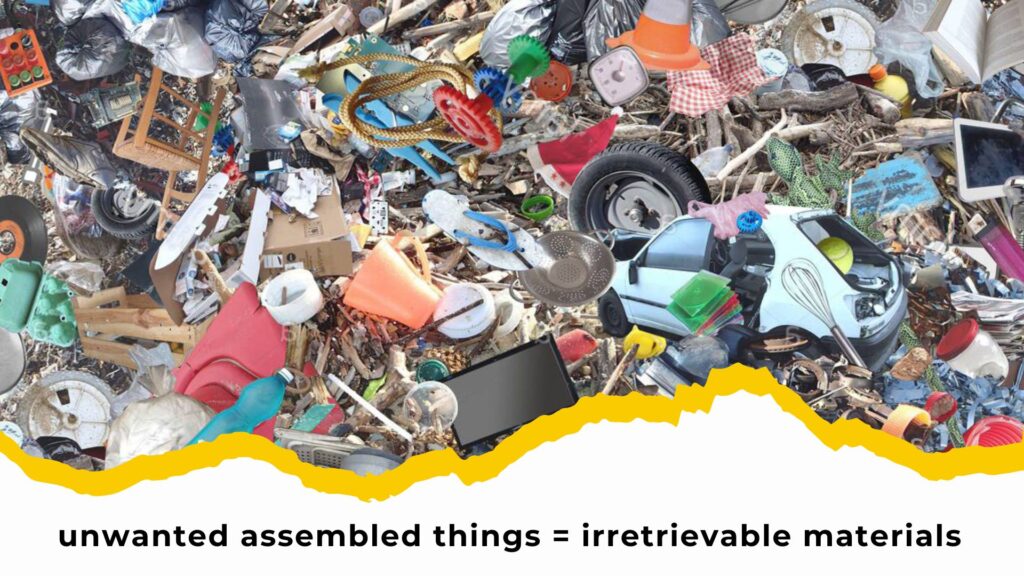
Recycling facilities claim that they are “not magicians” and although recovery technology is advanced, if collection is chaotic, there is little that can be done to recover anything.
Most recycling systems focus on recovering materials at the end of their useful life, as a last resort when it is not possible to reuse or repair a product. This requires a significant amount of energy and resources.
Recycling is certainly an important step in waste reduction, but it does not address the entire product life cycle and waste minimisation from the design and production phase.
It is only one part of a broader concept: the circular economy.
Circularisation: the new paradigm
A circular product goes beyond recycling. It is part of a circular economy system that starts with the initial design phase, which defines how the product can have multiple lives, reduce its environmental impact and minimise waste. It involves planning the product’s life cycle.
It is a product that is designed to be easily disassembled, separated and manufactured with sustainable materials so that at the end of its useful life, its parts can be efficiently reused. For example, they can be converted into raw materials that maintain their quality and can be used to make the same or other products. This is one of the great benefits of a circular product.
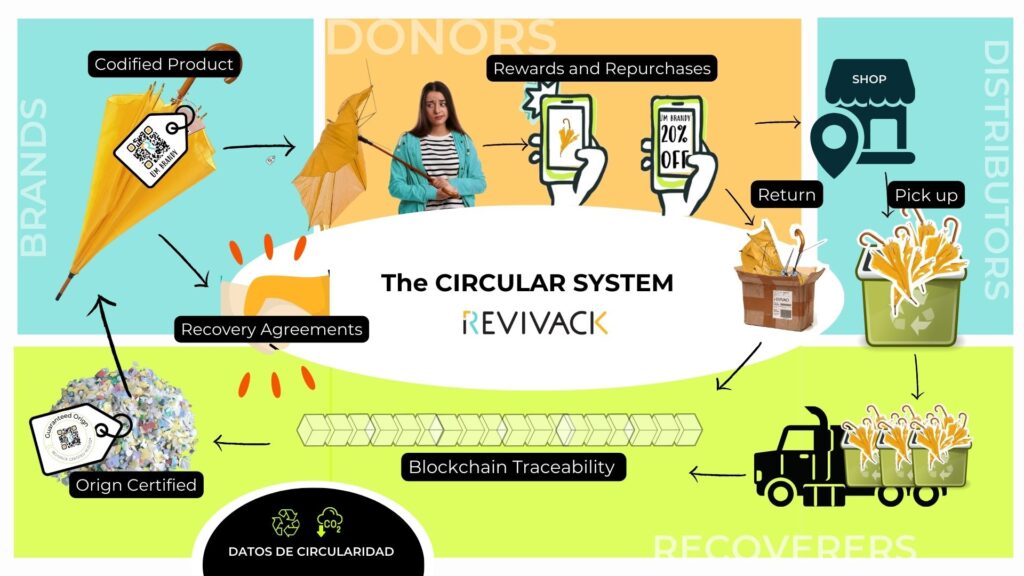
In fact, for a product to be circular, it must meet three requirements:
- Planned recovery
Planning the recovery of products before they are manufactured is essential. This not only increases the efficiency of the system, but also reduces costs in the long run.
By planning from the outset how a product will be recovered and reused, companies can design products that are easier to disassemble and reuse.
- Manage collection
Take-back and segregated collection are key practices to ensure that products go to the right places for recovery.
By having an organised system in place, companies can ensure that valuable materials are not lost in the waste stream.
- Transparency with traceability
In order to consider a product as circular, it is necessary to know where materials come from and where they go. Traceability allows us to determine the origin of the recycled raw material, ensuring transparency and trust in the process.
Circularisation is therefore not just about recycling, but also about closing the life cycle of products, from their design to their eventual reintroduction to the market as new products or materials.
What are the differences between a recycled product and a circular product?
Differences between a recycled product and a circular product
1. Recycling focuses on the treatment of waste, whereas the circular economy is about preventing products from becoming waste by design.
2. Circular products optimise the use of resources from the outset and promote continuous reuse.
3. Recycling is a tool to reduce waste, but circularity aims to reduce the need for recycling by extending the useful life of products and their components.
4. Circular products generally have a lower environmental impact by reducing the need for new resources and energy.
5. In the circular economy, recycling is the last option, with reuse and repair taking precedence.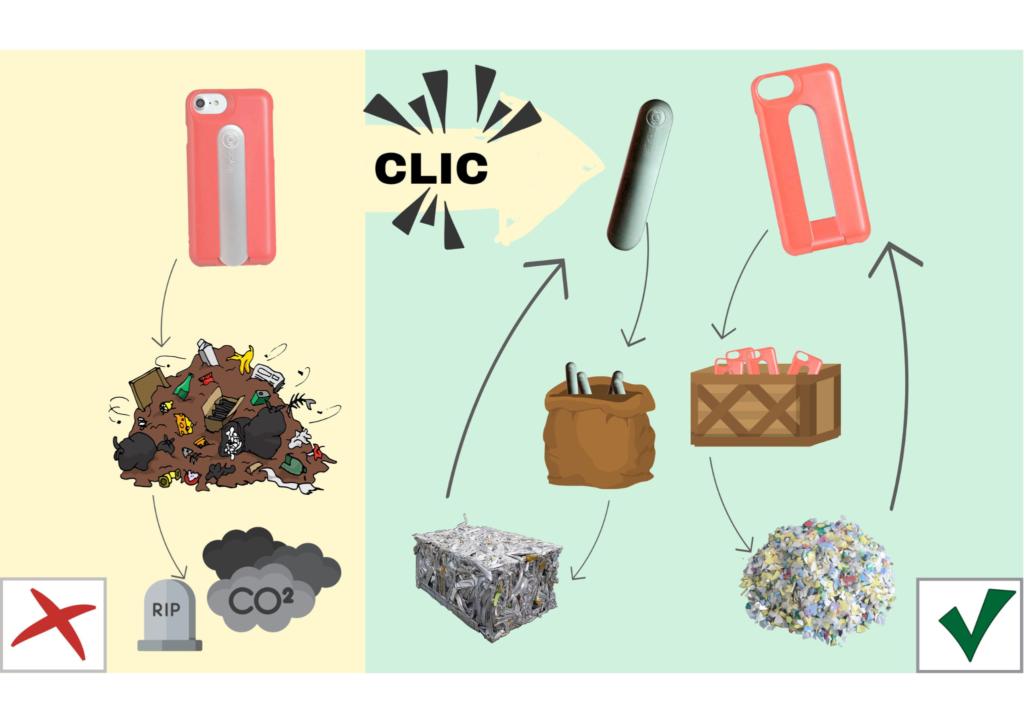
These differences allow us to identify the advantages of a circular product over a recycled product.
7 Advantages of a circular product over a recycled product
- Longer useful life: Circular products are designed from the outset to be reused, repaired and remanufactured, giving them multiple useful lives. Recycled products, on the other hand, have a limited life once they are discarded and processed.
- Reduced resource consumption: By focusing on reuse, circular products reduce the need to extract new raw materials. Recycled products require additional energy and resources to transform discarded material into something useful.
- Waste reduction: A circular model aims to minimise or even eliminate the generation of waste by creating products that can be reintroduced into the system. Recycling only deals with waste after it has been generated.
- Efficient design: Circular products are designed to be disassembled and separated, which facilitates recovery. In contrast, recycled products are not necessarily designed with this in mind.
- Reduced environmental impact: By avoiding the manufacturing and recycling process (which can be costly in terms of energy and emissions), circular products tend to have a lower overall environmental impact than recycled products.
- Traceability and accountability: Circular products allow traceability of the entire product life cycle, facilitating producer responsibility at all stages, from design to end-of-life. Traceability is more difficult to ensure for recycled products.
- Encourage innovation: Circular products encourage the development of new technologies and materials that facilitate repair, reuse and refurbishment. This encourages creativity in design and production processes, whereas recycling focuses solely on the transformation of materials at the end of their useful life.
At Revivack, we promote circularity!
Our blockchain-based reverse traceability and take-back system promotes product circularity by connecting people and businesses committed to sustainability.
We help manufacturers plan, manage and track the recovery of their products to make them circular.
We support recovery centers to increase visibility, transparency and trust in the waste recovery process.
And we facilitate the return of unwanted items on an individual basis for recovery, preventing them from becoming waste.
If you liked the advantages of a circular product, you may also be interested in 10 reasons to integrate the circular economy in your company or Tidy waste, the new concept for saving natural resources and reducing CO2 emissions