
When we talk about blockchain, our minds go irremediably to the dark and uncertain world of cryptocurrencies, the huge energy consumption and CO2 emissions it requires, or the lucrative business of non-fungible tokens and NFTs that, according to Bill Gates, are based on human stupidity.
However, blockchain technology goes far beyond the controversial world of crypto-assets, and offers disruptive solutions that are beginning to revolutionise the world as we know it.
These include the automation of processes and agreements without the need for intermediaries (smart contracts), the creation of secure digital identities allowing users to control their own personal information and verify their identity without intermediaries (digital identity), the tracking and management of copyrights and intellectual property more efficiently (property registration), or the tracing of products along a supply chain… or recovery chain (traceability).
Reverse traceability with blockchain as a source of truth and anti-greenwashing formula
The concept of reverse traceability usually refers to the documentation and recording of every step that something (a product, a container, a process) takes from its origin to its final destination. Tracking processes in the supply chain in the manufacturing of products is a growing field. But, can it be done the other way around? i.e. can a product’s journey at the end of its life be tracked to be recovered?
The answer is clearly yes. Although there is no consistent data yet, blockchain technology applied to traceability will have, and in fact is already having, a tremendous impact in the field of waste management tracking, establishing itself as a source of truth, transparency and trust, in the face of greenwashing and hoaxes.
And everything suggests that reverse traceability is here to stay, so that when it is implemented everywhere we will put an end, for example, to discrepancies such as those maintained by Ecoembes and Greenpeace about the veracity of such disparate data on packaging recycling, or we will see in a transparent way what big brands do with the used clothes they receive from their consumers. What do they mean when they say they ‘recycle it’? Where does it go? What percentage is recovered?
If we turn to reverse traceability as a source of truth, transparency and trust, we will put an end to the eternal discrepancies about the recovery of packaging and other products. Reverse traceability with blockchain is the real anti-greenwashing formula.
The concept of reverse traceability therefore refers to the tracking of the path of a product or waste from its destination to its origin, i.e. the tracing of an item after it has been discarded or scrapped.
This is of great value, as it allows verification of whether products have actually been recycled, recovered or properly destroyed. Reverse traceability with blockchain thus becomes an essential tool not only to ensure proper waste management, but also to combat greenwashing, which is the practice of giving a false impression of environmental responsibility. Thanks to the blockchain, information is immutable and accessible to all participants, ensuring that data cannot be altered or manipulated
What exactly is blockchain?
To understand why reverse traceability with blockchain is a source of truth, let’s take a moment to delve into the technology that makes it possible. A blockchain is a technology that makes it possible to create a decentralised network of information, i.e. it is like a catalogue of data that is not in one place, but is physically located in many computers at the same time, where the operation of the network does not depend on a single entity but is shared.
Imagine a digital ledger that cannot be changed or deleted. Each page of this ledger (or ‘block’) contains a set of transactions or data. Once a page is filled, it is closed and connected to the previous page (forming a ‘chain’). This means that everyone can see the log, but no one can modify it without agreeing it with others.
That is why the blockchain enables a secure and transparent record of information to be kept, because every transaction or movement that takes place in the process of transforming a waste or discarded product is permanently recorded in the chain. Once information is added, it cannot be modified or deleted, which ensures that all records are reliable.
Therefore, we can state that the 2 main attributes that characterise this technology in a major way.
 1. Decentralisation: Each party involved in the supply chain has its own access to information and can contribute to traceability. But that information does not end up in one place, because the irremovable information is distributed among many computers or nodes around the world. Therefore, if there is no single entity or server controlling the information, the possibility of fraud is reduced to 100%.
2. Transparency: All participants can see the same data record without any red tape, which builds trust. This means that anyone can verify the origin and path of a discarded item or waste.
3TR chains are the circuits through which we trace waste
If reverse traceability with blockchain is the ability to follow the traceability of a product in the supply or recovery chain, we will call the circuits that are drawn in this process CHAINS. If we also look at the 3 main attributes of waste recovery with blockchain, i.e. traceability, transparency and trust (TRust, TRansparency and TRaceability), it seems appropriate to give the name 3TR CHAINS to the flows that reflect each of the stages in the process of recovering a discarded object, from the time it is discarded until it becomes a raw material.

But how does this translate into real life? Let’s look at how fishing nets are recycled.
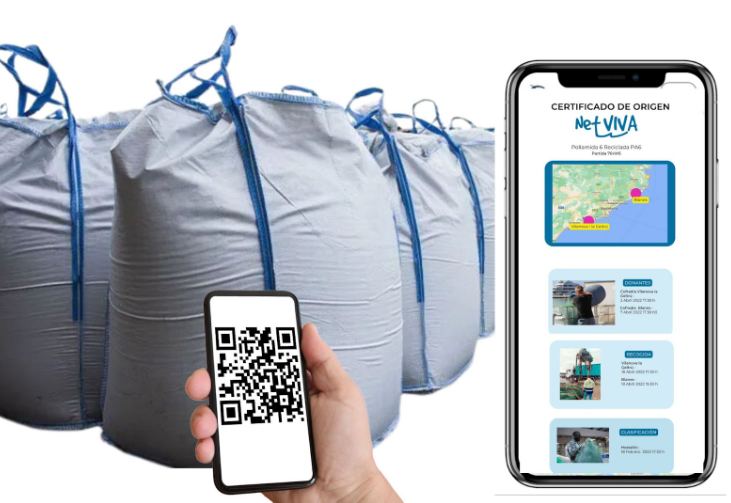
1. Nets donated. Antoni Vilamajor, skipper of the boat Àvia Barrineta in Vilanova i La Geltrú, fishes sardines and uses nylon nets. The nets wear out with use, and the time has come to discard 25 kg of them. He leaves the discarded nets in a container in the port, and realises that it is full. He notifies the fishermen’s association.
2. Notice of collection. The guild logs into the Reviviack application and notifies that the container is ready for collection. The notification data is uploaded to the Blockchain.
3. Collection. The net collector and net preparer receives the notification, prepares his truck and picks up the net container, leaving another empty one. The collection data is dumped to the Blockchain.
4. Separation. The collector takes the container of nets to the warehouse where they will be separated after a few days. We will get 3 different net containers: polyamide, polypropylene and polyethylene. All ready to be recycled. The separation data is uploaded to the Blockchain.
5. Treatment. If we follow the path of the polypropylene net container, we will see that the resulting container is sent to the company that will create the pellet. The treatment data is dumped onto the Blockchain.
6. Certificate of origin. The recycled polypropylene pellet bigbags will have a QR code that will lead to a public page where the path of the bigbags can be read, becoming a real Digital Certification of origin.
How to reconcile transparency and data privacy in 3TR blockchain blockchain-based chains of recovery
One of the main concerns for companies involved in a 3TR Chain of Recovery is data privacy, as the identity of some of the actors in the chain is confidential and is also a precious commodity that many companies guard jealously. How can you be transparent and private at the same time?
Blockchain technology offers effective solutions. Through techniques such as smart contracts and the use of cryptographic mechanisms, it is possible to maintain the privacy of the actors while guaranteeing the veracity of the information. Sensitive data can be encrypted and stored in such a way that only authorised parties have access to it. In this way, the necessary confidentiality is preserved without sacrificing the transparency of the process.
Within advanced cryptography, algorithms such as Zero-Knowledge Proofs (ZKPs) allow transactions to be validated without revealing the underlying data, ensuring that transactions are verifiable without compromising the confidentiality of the participants.
An example of commitment to this technology is the work of the company Eseleos, a technology consultancy specialising in blockchain, which focuses on traceability and data integrity in various sectors and which is also the technology partner of our project: Revivack.
Energy savings and minimal CO2 emissions in a 3TR blockchain
Previously, the blockchain used the consensus mechanism known as Proof of Work (PoW), which involved high energy consumption. In this system, network participants, or ‘miners’, competed to solve complex mathematical problems. This process is computationally intensive and therefore consumes enormous amounts of energy. In addition, due to the competition between miners, the process of validating transactions and creating new blocks on the blockchain generates a large amount of CO2 emissions.
However, blockchain technology has evolved and adopted Proof of Stake (PoS) as the new consensus mechanism. Unlike PoW, PoS does not require large amounts of energy to validate transactions. Instead, validators are selected to create new blocks based on the amount of cryptocurrencies they have ‘staked’ on the network, which significantly reduces energy consumption.
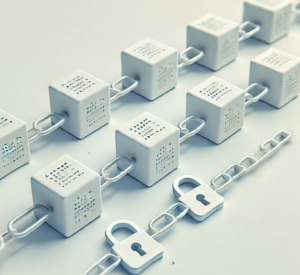 In addition to this change in the consensus mechanism, other optimisation systems are being implemented in the blockchain network, such as improving the efficiency of verification processes and transaction management, to further reduce CO2 emissions. These developments aim not only to make the blockchain more accessible and faster, but also to contribute significantly to the reduction of the carbon footprint, making this technology a more sustainable option in the long term.
Blockchain-based 3TR Recovery Chains at your fingertips
Creating a 3TR chain is now possible easily, quickly and cost-effectively with the Revivack system. Any company wishing to attest to its activity in the field of recovery of discarded items or waste can access the design and activation of a traceability circuit with blockchain technology. Do you want to learn more? Sign up and connect with our team, we will guide you and you will be able to start tracing in a reliable and transparent way right away!
In addition to the reverse traceability with blockchain , you may interested in Advantages of a circular product over a recycled product or 10 reasons to integrate the circular economy in your company.