

In a world facing increasing environmental challenges, the circular economy is emerging as a necessity rather than an alternative, which means it is also an opportunity.
While the mantra ‘Reduce, Reuse and Recycle’ has long been the mainstay of environmental awareness, today we are at a turning point that demands a broader and deeper approach.
The circular economy is not just a concept; it is a revolution in the way we think about production, consumption and resource management. Circularisation goes beyond simply reducing waste: it aims to reimagine the entire life cycle of products and materials.
This is where the 3Rs fall short and we need to broaden the framework. The 13R’s offer a more comprehensive framework for addressing the sustainability challenges before us.
The need to expand a new approach beyond the 3R’s
While the traditional 3Rs have been instrumental in starting the sustainability conversation, today’s landscape demands a more holistic perspective. The 13R’s we will explore in this post not only broaden our sustainability vocabulary, but also expand our ability to create innovative and lasting solutions.
Each of these R’s represents a unique opportunity to rethink our systems, redesign our products and rethink our consumption habits. From the initial conception of a product to its eventual reintegration into the production cycle, the 13R’s guide us to a future where waste is minimised and value is maximised at every stage.
Far from being superstition, the number 13 in this context symbolises a leap in our approach to sustainability. Each additional R brings us closer to a truly circular economic model, where resources are used efficiently, products are designed to last and waste is turned into opportunities.
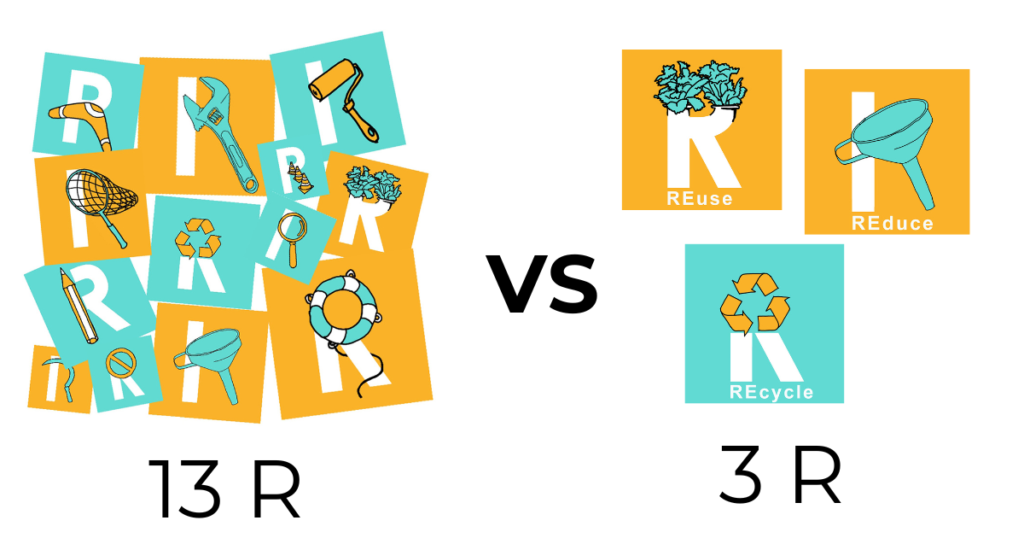
The Power of ‘RE’ in the Circular Economy
But more than just ‘R’, the true spirit of the circular economy is encapsulated in the prefix ‘RE’. This small, but powerful prefix denotes repetition, reversal or intensification of an action.
In the context of the circular economy, ‘RE’ symbolises a return to natural cycles, a reinvention of our production processes and a renewal of our relationship with the environment.
Each ‘RE’ invites us to take a step back, evaluate our current practices and re-imagine a future where resources are conserved, regenerated and constantly reintegrated into the system.
This focus on ‘RE’ also reinforces the central idea of the circular economy: a system that continually renews and reinvents itself, to achieve a perfect cycle of reuse. Let’s go for it!
The 13R’s of the circular economy, beyond the 3R’s
1. Reuse
 Reuse extends the useful life of products by giving them new uses, using an object, component or material for the same or a different purpose, but without modifying it. For example, using a glass jar to store food again.
But reuse in the context of the circular economy also goes further and seeks the transformation and reuse of materials into new raw materials, thus creating a continuous cycle of use.
The aim is infinite reuse and for this, products have to be circularisable: those that are traded by offering customers alternatives to be collected or returned, in order to be recovered and turned into raw materials again. For example, Wallapop, the portal for buying and selling second-hand goods.
Reuse has a different nuance, it implies using an object again to give it a new use or functionality. For example, using an old T-shirt as a cleaning cloth or making sculptures out of glass bottles. This approach promotes creativity and innovation, encouraging consumers and businesses to find ways to use existing items instead of purchasing new ones.
Both reuse and re-purposing minimise the demand for virgin resources and reduce the amount of waste generated, thus contributing to a more sustainable cycle. In addition, this practice fosters a culture of responsible consumption, where the value of products is maximised and their potential beyond their initial use is recognised. This is essential, as it is extending the framework of the 3Rs.
2. Repair
 Fixing damaged products instead of throwing them away helps to reduce the demand for new resources and reduces the amount of waste. Repairing means fixing something that is broken or damaged, without necessarily making it look new. For example, repairing a chair can mean changing one leg without painting it or making it look the same as the other three.
It is important to foster a culture of repair and maintenance. For example, in industries such as technology, the useful life of products can be extended through simple repairs, but the tendency is to replace those products with new ones with the consequences that follow.
Initiatives such as iFixit are dedicated to providing free repair guides and selling tools and parts to repair electronic devices.
3. Refurbish
 Refurbishing involves restoring an object to a functional or nearly new state, and often includes cleaning, refurbishing and, in some cases, upgrades. For example, refurbishing a mobile phone may mean replacing damaged parts, cleaning the casing and making sure it works properly.
Back Market is an online platform specialising in the sale of refurbished electronics, such as smartphones, tablets and laptops.
4. Renew
 It refers more to an aesthetic or functional change, where you are looking to update or modernise an object to keep it useful, to improve its performance without having to create something completely new.
You can renovate an object by painting it or changing the visible parts and this does not mean that it is as good as new again. Renovating a piece of furniture might involve changing its colour or upholstery without necessarily repairing structural damage.
5. Rescue
 The R of salvage in the circular economy refers to the action of recovering products, materials or resources that would otherwise be discarded or end up as waste.
Rescuing is not only about the physical recovery of these items, but also about raising awareness of their intrinsic value: it is about believing in the history of things, in the lived experience of each object and its potential to be transformed into something else.
By rescuing objects, a proactive approach to sustainability is encouraged, where each element is seen as an opportunity to be reintegrated into the productive cycle, reducing waste and promoting a more responsible and conscious use of available resources.
It is about being aware that products are recoverable and the small effort involved. Throwing away is easy, rescuing is being conscious.
In this sense, TerraCycle is an innovative company that specialises in recycling materials that are difficult to process, thus rescuing products that would normally end up in landfills.
6. Return
 Products that are sold are scattered around the world. One of the biggest challenges of the circular economy is to group them in large enough volumes to be able to recover them efficiently. That is why the action of returning an object becomes one of the greatest exponents of the Circular Economy.
But this requires a receiver, an entity that is committed to receiving and processing it in an appropriate and, if possible, transparent manner. But who would want to get into such a mess?
Fortunately, the producing brands themselves are starting to realise their responsibility, and some of them have started to launch campaigns to receive their products in exchange for rewards with the well-deserved applause of their own customers. Here are a couple of examples, Sailfish takes back wetsuits or Actia promotes the return of headphones.
Therefore, take back systems may soon become a reality, not only because it will be an obligation, but also because it is a powerful marketing tool that encourages customer loyalty towards brands.
7. Recover
 Recovery refers to getting value from waste and encompasses all actions that involve reducing waste and using it as a resource to produce new products, either in the form of raw materials or energy.
And what is the best way to recover in the circular economy? With separate collection, which ensures the creation of tidy waste for more efficient recovery.
Recycling centres receive thousands of tonnes of items that cannot be recovered because their parts are bound together and the materials are mixed. A company’s commitment to sorted waste involves creating a protocol for receiving discarded items, sorting them, storing them, separating their parts and recovering them individually.
There are initiatives such as Veolia, which is committed to recovering materials and energy from waste. They use advanced technologies to recover energy from non-recyclable waste and reuse materials such as plastic and metals.
8. Recycle
 Recycling is a way of recovering products or components by processing their materials into useful raw materials for making new objects. It is a last resort when repair or reuse is no longer possible.
This is precisely why it has its limitations: it is still linear and the product will end up as waste, as most products made from recycled materials cannot be recycled again and therefore the circle of the circular economy is not closed. This is also why it is necessary to go beyond the 3R’s.
9. Review
 In the context of the circular economy, the concept of reviewing refers to the constant evaluation of processes, products and materials to ensure that they meet the objectives of sustainability and circularity. ‘Review’ implies a critical and regular analysis of the different stages of a product’s life cycle, identifying areas for improvement in terms of efficiency, durability, resource use and waste minimisation.
This step is key to ensuring that products and processes are adapted to best practice, identifying possible improvements or failures that could compromise the circular cycle. Reviewing ensures that the strategies adopted remain effective and aligned with the principles of the circular economy.
It can also involve adapting to new environmental regulations, technologies or changes in market demands.
This is the case for Interface, a sustainable carpet company that constantly reviews its processes to ensure sustainability and resource efficiency.
On the other hand, rethinking means questioning our current production and consumption patterns. It means re-evaluating our real needs and looking for more sustainable alternatives.
By rethinking, we can design more sustainable products that are easy to repair, upgrade or dismantle for reuse or recycling.
This process leads us to innovate in design, materials and processes to create products and services that are more circular and benefit from the advantages of implementing the circular economy.
10. Redesign
 In the circular economy, the concept of redesign refers to the need to re-imagine products, processes and services from their conception to conform to the principles of sustainability. Rather than following the traditional ‘use and dispose’ model of design, redesign seeks to create products with a focus on durability, repairability, and recyclability, maximising their life cycle and minimising environmental impact.
Redesign involves, among other things, choosing materials that are recyclable or biodegradable, reducing unnecessary components, and developing modular systems that allow for easy repairs. It also encourages innovation in the creation of multifunctional and adaptable products that can be kept in the use cycle for a longer period of time before being discarded.
11. Reduce
 Another classic of the 3Rs, essential, but insufficient.. Reducing is much more than simply using less. It is about optimising the use of resources throughout the value chain. This includes reducing the consumption of energy, water and raw materials, as well as minimising waste generation in production and consumption processes.
Minimising the amount of resources needed from the outset helps to reduce the environmental footprint of products.
12. Reject
 Refuse is an essential principle in the circular economy that emphasises the importance of avoiding unnecessary consumption and waste generation from the outset.
This practice involves making conscious decisions about which products to purchase, prioritising those that are truly necessary and that meet sustainability criteria, which promotes a more responsible and thoughtful consumption culture.
Rejecting not only refers to avoiding single-use or low-quality products, but also to opting for more sustainable and ethical alternatives, such as those that are designed to last or that come from responsible sources, or to discarding non-recyclable materials when producing a product.
One example of a company that practices the principle of rejecting in the circular economy is Patagonia. This company promotes conscious consumption and encourages its customers to reject unnecessary consumption. It promotes buying only what is really needed and encourages its customers to repair products before replacing them. They have even launched campaigns such as ‘Don’t Buy This Jacket’ to discourage overconsumption, an innovative and ethical approach that supports a more sustainable economy.
13. Revolutionise with REVIVACK
 At Revivack we are facilitators, we want all actors who want to participate in the circular economy to find in our platform a simple way to connect and recover.
Do you want to be part of circularisation? We help you to plan and manage the recovery of your products in an orderly and transparent way.
Revivack is the world’s first system, based on blockchain technology, that facilitates the individual return of unwanted items to their own producers (or qualified entities) so that they can take them back in an orderly, transparent and reliable way, thus helping to promote the circular economy.
Everyone can become a Revivers! You just need to have the will to prevent objects from becoming waste –contact us!
If you are interested in going beyond the 3R’s, we recommend you take a look at the advantages of a circular product over a recycled one or 10 reasons to integrate the circular economy in your company.